Thursday, October 27, 2022

Fall Projects


 Fall is a busy time of the year. The leaves are beautiful when they display their colors but piled up on my decks, sidewalks and doorways not so much. Daily cleaning with the blower and raking and collecting the leaves to feed the many compost piles is quite a chore. Picking up hickory nuts to keep them from being slung through a window by the mower is another chore. I did manage to get Gypsy my little Scottie bathed and clipped and performed a bumble foot surgery on one of the duck hens. Patient and doctor are recovering nicely. Geez the hats I wear sometimes are just mind blowing.

I have been concentrating on dehydrating frozen fruit to clean out the freezer some. Jars of dehydrated okra, figs and herbs put in jars removing the oxygen with oxygen absorbers or my vacuum sealer. I reuse lids for these and have never had a problem. 


Dehydrated figs are addictive. 


Dehydrated okra is not only great for soups and gumbos but makes a nutty snack out of hand.


I got the last of my retired laying hens butchered and canned in chicken broth. Now all I have are my new batch of young Buff Orphington pullets. These young hens should be laying within the next month or two and I will just have to make do with duck eggs for a bit.  My chicken house and duck house are cleaned out and fresh bedding applied. 

SO I am going into fall with ever growing compost piles, the fall garlic planted, the fall butchering done and canned, and my dehydrating knocked out. I have started gathering and drying okra seeds and my other vegetable seeds are now dried and in the freezer. 

My project for the day is canning blackberry pie filling with a couple gallon of frozen blackberries. O Wise One is cleaning and getting walnuts ready to crack. We did not get a great walnut harvest this year probably due to low rainfall but a few for holiday baking will be nice. 

With the wood shed full winter heat is prepped. While we have a gas furnace we always stockpile firewood for those power outages that seem to always pop up when you least expect them.  So we go into the season knowing that we have done all we can to prepare ourselves for the upcoming winter. While the nation struggles we seem to have worked out the food and heat dilemma for the time being. 

Blessings from The Holler
The Canned Quilter


Thursday, October 20, 2022

Canning Butternut Soup


 It has continued to be a busy time here in the holler. First frost has come and gone a week early no less and we have had 3 consecutive night of freezing temperatures. We did finally get a small amount of rain but it continues to be really dry for this time of year. Before frost we scurried around picking everything we could. One of those vegetables still out there was Butternut quash. They were growing on vines in various parts of the garden up fences and trellises and left to ripen and the skins harden in the cool weather of fall. Once that frost danger approaches they must be picked though. 


All together I picked about 14 off of 3 vines so not bad for a harvest and plenty for the two of us. This really is one of those plant and forget crops for me. I add plenty of compost when I plant and occasionally train the vines on fences and wires and forget until time to pick. I do prefer to grow the vertically though. 


The first three I picked I peeled then chunked up and covered raw with some rich chicken bone broth then pressure canned for 90 minutes (quarts) at 12 pounds of pressure for my altitude. They turned out beautifully and will be used to make butternut soup once opened, heated and pureed with an immersion blender. Then I will add cream and a flour and butter roux as a thickener for a rich and creamy winter soup. Served with fresh garlic croutons and crumbled crispy bacon bits on top.


The seeds were saved and are drying on paper plates while the largest ones will be used for seed stock to replant for years to come. The extra seeds will be roasted in the oven for snacking

With 11 more squash to go I will bake some of these and scoop out the meat to mash and freeze for holiday pies and breads. 

The fall season is beautiful right now with the leaves turning colors and we have been enjoying nightly fires with the cooler temperatures. We have been gathering lots of walnuts and wild persimmons. I still have a bit of canning to do with frozen fruit that was picked earlier in the year. A couple gallon bags of blackberries again need to be made into  pie filling and canned to clear some space in the freezer. We have a pig that is being butchered from a local farmer next month so I need to make room. 

Blessings from The Holler

The Canned Quilter


Wednesday, October 5, 2022

Dehydrating Figs


I have 6 fig trees now here in the holler. Three are the variety Chicago Hardy and the other three are an unknown variety gifted from a friend. Some winters they freeze all the way to the ground and some years they don't but they always come back and every year they are bearing more and more figs. The picture above is of an ordinary size fig on the bottom and the huge size figs I get off the unknown variety on top. It does not turn dark purple like the Chicago Hardy nor do I think it tastes as sweet but the greenish unknown variety can get HUGE! They usually start getting ripe by August and bear until the frosts of October. There are always figs on the trees though that do not have a long enough season to ripen before frosts but I always get enough for my family so I am happy. 


I have 4 large gallon bags of figs frozen for fig jam or preserves that I will take out and do once things slow down but for now I am dehydrating figs daily. I simply slice them thin and dehydrate until rubbery which if I pick early in the morning they are done before I go to bed at night. They end up so sweet that way and are great as snacks or in trail mixes but our favorite way to use them is to add them to our refrigerator oats with some maple syrup or local honey and almond milk.   

Figs and blueberries have become my easiest and best producing fruits. No diseases or pests problems for me and fruit production grows every year. No spraying, easy to propagate and mine require very little pruning. I used to wrap them in winter when they were young but now that they are established I just let winter do what it will and I haven't lost one yet. And for some reason the birds don't even mess with them much maybe because there is so much other stuff to eat like elderberries. Boy they love them. 


I keep my dried figs in Rubbermaid containers until I get enough then I move them to Mylar bags with oxygen absorbers. I have in the past also stored them in Mason jars with oxygen absorbers. 

I will warn you though that dehydrated figs are awfully addictive . 

Blessings from The Holler

The Canned Quilter

Monday, October 3, 2022

Cocozelle Zucchini


Well we finally pulled up the zucchini before frost. There is too much of a good thing! My favorite variety of zucchini to grow is an old Italian heirloom called Cocozelle. This Italian heirloom was called Cocozella di Napoli in the 1800s. It is a smaller bush but bears prolifically with a sweet and nutty tasting fruit. Flavor wise this is my favorite. It is open pollinated and I save seeds.


Zucchini for me is a pretty no brainer crop and I usually always end up with way more than I need but the chickens love them so they just become food supplements for the chickens and rabbits. 


My husbands favorite zucchini recipe is the zucchini bread that I have made for years. I always make up a dozen loaves or so and freeze for winter. 


Zucchini Bread

3 cups all purpose flour
1 tsp salt
1 tsp baking soda
3 tsp ground cinnamon
1/4 tsp baking powder
3 eggs
2 cups white sugar
3 tsp vanilla extract
1 cup vegetable oil
3 cups grated zucchini
1 cup chopped walnuts optional
1/2 cup raisins optional

Preheat oven to 350. Sift together flour, salt, soda, cinnamon, and baking powder. Beat eggs. Add sugar, vanilla and oil to egg  and mix well.  Add zucchini to egg mixture. Add dry ingredients, mixing well. Stir in nuts and raisins if desired. Pour into 2 loaf pans. Bake at 350 for 1 hour.. or until tests done. Cool on rack and then remove from pans. May be drizzled with a powdered sugar and milk glaze.  


Or maybe zucchini pineapple canned. 

ZUCCHINI PINEAPPLE

4 quarts zucchini, grated or diced
1 1/2 cups bottled lemon juice (standardized acidity)
1 can ( 46 oz. ) unsweetened pineapple juice
3 cups sugar

Remove peel from zucchini and seeds. Coarsely grate or cube zucchini into small cubes.

Mix all ingredients thoroughly and simmer for 20 minutes, stirring frequently. 

Fill clean hot jars with hot zucchini mixture leaving 1/2 inch head space. Adjust lids an
process 15 minutes for half pints or pint jars. ( Do not put in jars larger than pints. )

Remove jars and allow to cool completely. Test seal and store in a cool dry place. 


 And I even have 4 baseball bat sized ones on the table for seeds.


Blessings from The Holler

The Canned Quilter

Friday, September 30, 2022

Dehydrating Mashed Sweet Potatoes


Other than just consuming my sweet potatoes baked this is one of our favorite ways to consume sweet potatoes other than maybe pie. I simply put the sweet potatoes in the oven and bake them. Then peel the potatoes and mash just like making mashed potatoes. I add apple juice if they need a little liquid and I add to also add cinnamon and maple syrup and then run my immersion blender through them. You do what your family likes to taste. Then I spread the mashed potatoes out on parchment paper on my dehydrator trays and dry like fruit leather only drier. At the end I take it off the parchment paper and let it finish drying to a point it can be broken into small pieces. 


The sweet potato pieces are in the jars in the above picture. You can easily take out small pieces and just let them melt in your mouth. We personally like to add them to our refrigerator oatmeal again. A great source of potassium. They can also be reconstituted as just plain mashed sweet potatoes or used in bread, pies and casseroles. 

Blessings from The Holler

The Canned Quilter

Wednesday, September 28, 2022

Heavy Hitter Okra


Another overachiever in my garden this year has been the okra. I tried a new variety to me called Heavy Hitter from seeds I purchased 2 years ago from the farmer in Alabama that developed this okra. In the past I have traditionally grown Cajun Cowhorn variety and also Clemson SpinelessCajun Cowhorn is an heirloom variety that my parents grew in Louisiana when I was a child and the great thing about that variety is that the pods stay soft and edible even when very large. Heavy Hitter is a variety developed by a farmer over many years by selecting the best producing Clemson Spineless plants in his garden and saving seeds from those specific plants. It is known to be an extremely heavy producer and has lived up to it's name. I see it is available now at Bakers Creek Seeds if anyone is interested in trying it. I will say that it has produced spectacularly for me. We did have an extremely cool spring and it was slow to get started but once started it will produce now till frost. I found the seeds just a tad expensive at first but now save my own so have plenty for years to come. I also maintain a supply of Cajun Cowhorn seeds as well. 


Like any other okra Heavy Hitter makes a beautiful yellow Hibiscus type flower and a large bush. My okra in the garden and around the place tucked here and there are between 8 to 12 feet and some are 4 foot wide so give them plenty of room to grow. They also like rich soil and produce well in heat and even dry conditions to a point. I like to cut my okra pods  from 3 to 5 inches in length so that they are good and tender. 


Right now I am averaging about a gallon of okra a day. I have frozen about 40 vacuum bags with 4 cups each now in the freezer. This we love just tossed with olive oil and sea salt and roasting in the oven.  I have also canned okra and tomatoes in jars for making a dish that starts with a traditional roux with shrimp and onions served over rice. It is just okra, tomatoes and onions in the jars. I also use this in soups as well and sometimes gumbos. I have also frozen okra breaded for frying. 


So for now we are dehydrating okra. My husband eats it straight out of the container as a snack because it takes on somewhat of a nutty flavor. Dehydrated okra will eventually once I am finished go into Mylar bags with an oxygen absorber and be stored in food grade buckets with gamma lids. This way it should keep for years as long as it is dried completely crunchy. Rehydrated okra can be used roasted, in soups or even breaded and fried. It all works and no slime! 


There is also a pickled okra recipe under canning recipes above if you want to give that a try. 

Blessings from The Holler

The Canned Quilter


Monday, September 19, 2022

Plentiful Harvests for Autumn


The days of sleeping at night with an open window under a snuggly quilt have returned. The leaves have started to trickle down again from the trees. I picked the first 6 of my butternut squash yesterday. I love the "pumpkin" pies I make from these. In the past I have chunked these up and canned them in jars but honestly I don't like them that way. The meat of the squash tends to be watery preserved that way. My preference actually is to mash the squash up and freeze it. I may play around with dehydrating it into a powder this year and then rehydrating for pies. We shall see since I have plenty to work with. You have to make sure when growing these winter squash to leave them on the vine long enough for that rind to get good and hard. That is the secret to a long shelf life. 

I have been playing around with the idea of canning chicks of this squash in jars with chicken broth and maybe onions. You could open the jar and simply puree the contents and maybe add cream for an almost instant butternut squash soup. I see some more experimenting in my near future. 
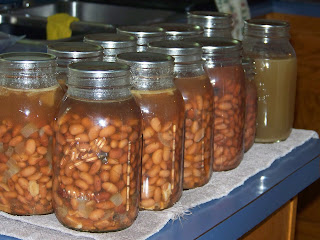


My eldest daughter "Fred" came to visit recently bring my grandchildren to spend some time. She had recently butchered and brought me meat builder chickens she had raised along with some fresh pork. O Wise One smoked it last week and I used the smoked chicken to make a couple casseroles for the freezer. The chicken bones had a smoky flavor and I made a small crock pot of smoked chicken broth to use to can. That should give something an interesting flavor. With the smoked pork I had some dry pinto beans laying around so I cooked my pinto beans just until soft then added them to jars along with chunks of the smoked pork and some chopped onions then poured the smoked chicken broth over the top to fill the jars to 1 inch headspace. Then I processed these quart jars for 90 minutes at 12 pounds pressure. Talk about good it made quart jars of pinto beans with onions and chunks of smoked pork. Add some corn bread and a sliced tomato fresh from the garden and you have a great meal. The extra broth I put up in 3 quarts also. Just 1 batch of seven quarts but that is seven meals for us out of one piece of pork. Three freezer casseroles ( 8" X 8") with smoked chicken stashed in the freezer and a little extra broth as a bonus. So all together 10 meals for 2 pieces of meat. 


We picked the last of the Red beans from the garden also and canned 6 quarts of Louisiana Red Beans then pulled up the plants for the compost pile. One more crop finished for the year. I had been low on Red beans and concentrated on growing these to replenish my stock. We had made some homemade rope sausage last month and out in the freezer to go with these beans and also to go with my fermented homemade sauerkraut in the fridge. Louisiana Red Beans and Rice are a comfort food from home for me and we managed to can 60 quarts of them this season to add to the pantry. For the two of us that is 60 meals. 


My cucumbers are also starting to slow down so I made a small batch of 7 pints of dill relish. I use this for tuna, egg and chicken salads for sandwiches in the winter. This should again last us until the next cucumber harvest next spring/early summer. 


Another bumper crop for the year has been yellow squash. 2022 shall be remembered as the year of the squash. I have 5 gallon zip bags of blanched sliced squash waiting to go into vacuum bags for the winter not counting what I have already put in vacuum bags. My plain old yellow crook neck squash was definitely an over achiever this year. These we like to eat with just a touch of bacon and onion smothered in a skillet. Sometimes I may add a sprinkling of shredded cheese over the top. 

I also make a cream of squash soup with chicken broth, pureed squash and cream. A great fall soup to use up those extra squash. For this soup I freeze pureed squash in containers then remove from the containers and vacuum seal to go back in the freezer. Again to free up some freezer space the same idea of canning with chicken broth would work. Another experiment for the future. 

The squash plants too have been pulled up and added to the compost. 

I have 4 giant striped heirloom Italian zucchini named "Cocozelle" on my table awaited to be seeded for seed for next year and the meat I will shred for zucchini bread to go into the freezer. 

So as the temperatures mellow and the leaves begin to fall we start to also forage walnuts from the neighbors walnut tree that we gather every year to put in the freezer for our holiday baking and additions to our morning refrigerator oats. The cycle continues for another year here in the holler. The firewood is stacked, the fall garlic awaits planting next month and the compost piles grow ever larger. Soon shredded leaves will start being added to the compost and they will really swell in size.

Our spring baby ducklings were added to the flock this morning. We kept three little hens. So we now have Tiddly Winks my little pocket duck, Thelma the original hen and Tassy Lou the addition last year from a neighbor. Added to the mix now are Tink, Tilly and Tammy Faye.  Angel is one happy drake with his harem of T's. Angel was named after one of Baby O's past boyfriends. The six little pullets are growing like mad and will replace the hens now in the chicken yard that will be butchered soon as they are at the end of their laying cycle. Their meat and subsequent broth will go into jars for winter meals.

Life goes on and we await the imminent first frost sometime next month. 

Blessings from The Holler

The Canned Quilter

******* Notation

Barbara asked an excellent question about old hens being tough. These old hens are called stewing hens. A stewing hen is a retired egg layer. Stewing hens are an important component for honoring the life cycle of a farm. After several happy years eating grass and bugs, a hen’s egg laying ability naturally slows down, and she’s no longer a productive member of the flock. In order to keep up with the demand for eggs, farms must cull these older hens in order to make space for new layers. Butchering and selling these hens provides a revenue source for farms and allows the hen to continue to provide nourishment, this time in the form of high quality, pastured meat.

Unlike broilers that are raised for meat and fattened relatively quickly, stewing hens have the opportunity to develop very strong bones, and strong, lean muscles. These bones are incredibly mineral rich, and the fat from these hens is full of fat-soluble vitamins and nutrients. Because of their rich nutritional content, stewing hens make excellent stock. A stewing hen’s lean meat contains a high level of connective tissue, which works wonderfully for slow cooked dishes such as stew, soup, and chicken and dumplings.

Friday, September 16, 2022

Gooseberry Jam


Harvests are starting to slow down some. Yesterday I picked the first of the winter squash which is a butternut variety. I don't even know what variety as I first saved the seeds from a squash purchased commercially long ago. For the moment I am starting to process down some of the fruit that I tucked in the freezer this spring until I had time to process at a later date. I grow so much that I have to do this often times to get around to everything.  SO I make jellies and preserves in the fall to cleanout the freezer for fall meats. 

First thing I did was take out my frozen gooseberries to thaw for a recipe I am posting a table below from the National Center for Home Food Preservation on canning jams and jellies with no added pectin
if you want to use pectin you can usually find the recipe in the Sure-Jell Box. As for me I just add sugar and in some instances lemon juice. 


Table 1. Ingredient Quantities.
FruitCups Crushed FruitCups SugarTbs. Lemon JuiceYield (Half-pints)
Apricots4 to 4-1/2425 to 6
Berries*4403 to 4
Peaches5-1/2 to 64 to 526 to 7
* Includes blackberries, boysenberries, dewberries, gooseberries, loganberries, raspberries, and strawberries.

I had a pretty healthy gooseberry harvest this year and froze most of them so I had lots of gooseberries to work with. I made jam with some, pie filling with some and then canned some simply in a super light syrup for juice to add to ice tea similar to lemon juice. 


It was pretty simple and straight forward with 4 cups sugar and 4 cups fruit cooked down to the soft gel stage and then put in jars and water bathed. I like canning in these small batches when I have a bit of time here and there. 


Blessings from The Holler

The Canned Quilter

Tuesday, September 13, 2022

Sweet Potato Time


Sweet potatoes are a family favorite in our house. I have such fond memories of my father when I was a girl and walking into his workshop and he would put sweet potatoes into the oven that he kept his welding rods in to slowly bake. The smell of baking sweet potatoes even today always make me think of him. He told stories about when he was a young boy taking baked sweet potatoes to school in his lunchbox during the Great Depression. I guess that crop got many southerners through the hard times. 

For me my sweet potato crop started in January with 2 left over sweet potatoes from the year before. Toothpicks were stuck in the sides and they went into Mason jars in the sunny kitchen window.  That was their home until about April as they put out sprouts and grew vines. 


About mid April I started rooting those sprouts in water preparing to set them into beds the first of May when the chance of frost had passed. We had already  prepared wire rings with a lining of black plastic to gather heat and then filled the rings with rich soil and compost. 


By July they had filled in the rings and ran out into the area underneath the two small pear trees I had started last year. We watered occasionally when Mother Nature failed to drop enough rain and other than that we just watched them grow. No fertilizer was added because there was plenty of compost already in the soil in the rings. And the temperatures turned hot and they loved it.


About two weeks ago we dug the potatoes composting all the vines.


And out of those two rings we harvested over 60 pounds of sweet potatoes. The rings were dismantled and the soil spread out to enrich the soil under the pear trees. 


We allowed them to sit on a tarp in the shed for a few days for the skins to harden and dry out. They are now sitting in a corner of the dining room in banana boxes continuing to dry out and season. I check them often to make sure there are no soft ones or rotten spots.

Once I am secure in the fact that they are seasoned I will move them under the bed in the guest bedroom. It is dark under there and cool because I keep the heat turned down in there because there is rarely any one sleeping in there. 

The really small ones or the nicked ones I am saving and will make sweet potato bark with later in the dehydrator. I'll do a post later to show you how. For now that is one more crop down as we head toward winter.

Blessings from The Holler

The Canned Quilter 


Sunday, September 11, 2022

Tomato Products


As  the rest of the country anticipated a shortage of tomato products in our future according to the recent  exploits of the media here I sit. Hip deep I tell you in nothing other than tomatoes. For the second year in a row a bumper crop of good old homegrown tomatoes. These days my kitchen table, kitchen counters and any other flat surface I can find is covered in seeds drying, vegetables ripening, vegetables waiting to be washed, blanched, chopped, dehydrated, frozen or canned. There is no tomato product shortage in The Holler. 
 

You can find tomatoes as they ripen cooking down in roasters and crockpots waiting to go into yummy dishes of some sort. These will be run through the immersion blender for homemade tomato sauce. 


On the table Rotel tomatoes in pint jars, Quarts of okra and tomatoes, canned chicken, watermelon seeds drying along with ripening tomatoes and green peppers. 


I caught navy beans on sale for $0.50 cents a pound so I bought 5 pounds. Came home and added onions, hamburger, maple syrup and homemade tomato sauce for 24 pints of barbecue beans.


I an also still processing fresh red beans. 


Yesterdays endeavor was taco soup with 3 pounds of dried black beans cooked until soft, 3 pounds of burger, and 3 pounds of corn, add hot peppers and onions chopped along with chili powder, cumin, homegrown garlic  and lots of cooked down fresh tomato sauce and I canned 12 jars of taco soup. 

Yes indeed the tomato products are flowing right now in my kitchen. 


Blessings from The Holler

The Canned Quilter

Related Posts with Thumbnails