Showing posts with label Butchering and Curing Meat. Show all posts

Friday, April 8, 2022

Homemade Breakfast Sausage

 
With the recent events around the world and talk of food shortages I have changed my habits a bit here at my home. Doing our best to understand and adjust to an ever changing world around us. Normally I allow my freezers to slowly empty during the year only to refill them mostly with the spring and summer garden harvest and then restock meat in the fall from the local farms. Usually pork and beef mostly. We do raise some of our own chickens and also purchase some. Sometimes my son who is a hog hunter also brings me pork from his hunts. Instead of letting those 3 freezers run somewhat low this year and those jars to sit around empty I am refilling them as I go right now. I am concerned about not being able to get certain items later in the year. My husband has dubbed it " Operation Keep Them Full". Kind of a don't get caught with your pants down move for us. 

As I run across sales throughout the next months I will continue to stock up on sale items and run my canner and dehydrator throughout the spring and summer. I will continue to also buy meat on sale as I run across it as well. This is in addition to my own normal garden and fruit harvest. Those sales are still out there you just have to watch for them. I ran across chicken legs and thighs the other day for $0.39 cents a pound at the local save a lot grocer. I bought 30 pound in frozen 10 pound bags and will show you what I can do with them in future posts. 


We are fortunate that many years ago, almost 40 now we invested in grinders, sausage stuffers, meat bin mixers, slicers and even a tenderizer. They have all been excellent investments through the years and I cringe to think what they would all cost us now to replace if you could find them.


In this particular case we caught pork butt for $1.69 a pound at a small community IGA. In these particular times any meat under $2 a pound gets my attention any more. We bought 20 pounds and brought home and trimmed the fat off and deboned then  froze for later use. 
 

Then we defrosted about 4 pounds of meat and ground up with our small grinder and made breakfast sausage. Now a one pound roll of breakfast sausage around here runs about $3.50 a pound in the supermarket. We added our own seasonings from the recipe below.

Breakfast Sausage Seasoning

2 pounds ground pork
2 tsp salt
1 tsp black pepper
1/4 tsp dried marjoram
1 Tbsp brown sugar
1/2 tsp thyme
1 Tbsp sage

To shape I used a canning jar lid and ring. Insert the flat lid in the ring and grease the inside. Stuff the lid with ground sausage and flatten. Then flip over on waxed paper and push on the flat lid. It will come out of the ring and then simply remove the flat lid off the top of the patty. I like this size because it is the same size as my biscuit cutter and my sausage will fit perfectly on a biscuit. Add a fried egg and a slice of cheese and you have breakfast. It's a perfect plan. 


With 4 pounds of meat we made 42 breakfast patties. We froze them on baking sheets covered with waxed paper and then vacuum sealed with 2 to a pack resulting in 21 packages. Small packs for a small household and vacuum sealed to prevent freezer burn. Cost per patty $0.16 cents. And no preservatives or artificial dyes of any kind. We control the amount of fat, salt and sugar in each bite. 

For us our own personal food certainty in uncertain times when it comes to food. These could be canned as well. And here we are as elderly Americans endeavoring at maintaining control of our food, our health and our own food security even though we live in what would be considered a food desert in today's society. 

Blessings from The Holler

The Canned Quilter

******************************************
I can also be found at 

Monday, June 8, 2020

Meat Bargains


A week or so ago I stopped by a small local grocery store to grab a couple cans of coffee on sale. Turkeys caught my eye for .99 cents a pound on a managers special, this one was 16 pounds. It cost me a hair under $16. I bought two. At a time when threats of meat shortages are hanging over our head any meat under $1 a pound catches my eye. 


I took them home and put one in the freezer and thawed this one out. O Wise One skinned it for me.


The skin and trimmings went in a bag for a pot of broth later.


Then he cut off the breast meat and put it on a baking sheet and I put it in the freezer to firm up for a bit. 


Then he sliced the breast meat into turkey cutlets. These will make great additions to our make ahead meals. It ended up being 20 cutlets. These are great in any recipe that calls for chicken breast.


The remainder of the meat he cut off the bones from the legs and such and ran it through the grinder. Ground turkey is very versatile and we use it just like ground beef. I use it sometimes to make a white chili.


At a time when lean ground beef is going for $4  and more a pound this alone would be $16 worth of meat.


And we had 8 bags of cutlets to go in the freezer. 2 cutlets each in 6 bags and 2 bags had 4 smaller cutlets. So that is cutlets for 8 meals.

And 6 pounds of skin and carcass was put in a bag in the freezer to pull out on a rainy day and process and can for turkey broth in jars. SO for $16 i can possibly make 12 meals  from that 1 bird not counting broth. Average cost $1.33 a meal for lean white meat is a good bargain in this day and time. Especially with meat prices what they are today and meat availability questionable.  


Blessings from The Holler

The Canned Quilter

Tuesday, April 15, 2014

Goose Breast


Wild goose season was recently open for snows and blues which are types of wild geese. 


O Wise One took advantage of goose season recently and we froze several trays of goose breast .  


Goose breast is a very dark and rich meat almost like liver. 


If anyone is interested I will try to do a couple post on how to cook it. As you may have guessed geese are plentiful in this area and the area used to attract goose hunters from all over the country. The sport is not nearly as popular as it once was. O Wise One was raised eating wild goose meat. This is one meat that I do not particularly care for. 

Anyone else out there ever ate wild goose?

Blessings from The Holler

The Canned Quilter


Monday, November 11, 2013

Skinning A Turtle


Both my husband and I having grown up in the country have eaten many kinds of meat other than the traditional beef/pork/chicken purchased at your local corner grocer. My own grandfather trapped to supplement his income and O Wise One's grandfather trapped also. Many of the ways of trapping and skinning were passed down to O Wise One from his grandfather. As for myself having grown up literally on the banks of a river in southeast Louisiana much of our meat came from the rivers, bayous and swamps surrounding us. Crabs, shrimp, crayfish, frogs, turtles, fish and rabbits were just part of the local fare. 

Recently after mentioning in a post about butchering turtles several of you expressed interest so I decided to do some posts on turtles including butchering, preparing the meat and canning and then a post on cooking it.  To start this string of posts I am going to post how to kill and butcher them. For those of you that are squeamish DO NOT READ this post past this point!  


First problem is finding your turtles. We butcher snapping turtles. Not sliders or stink pots but snappers. Back home in Louisiana some call them "cooter" turtles. Be careful handling these babies because they don't call them snappers for nothing! Snappers are usually found near water and many times neighbors will bring us one that was caught on their hook while fishing the local farm ponds and rivers. In the spring many times you can find them crossing the back roads during mating season. Safest way to pick them up is by the tail!! Common snapping turtles are not endangered however their cousin the alligator snapper is rare but are not found this far north.  

Always check with your local wildlife conservation department for laws on harvesting turtles in your area. In Missouri you must have a valid fishing license to possess turtles. A daily limit is 5 and possession limit is 5. 

We are picky about where our turtles come from. You do not want a turtle out of someone's sewage lagoon. Most of our turtles come from farm ponds or rivers.  


Once we have a turtle they go into an old watering tank set out under a shade tree by the garden. We want to keep them in there for about 6 to 8 weeks. We do this to flush the mud and impurities out of them that can collect in their shells and constantly add clean water as it evaporates and we even change the water regularly so that they always are in really clean water. During this time we also feed them. My husband saves fat, skin, gizzards, hearts and such from butchering chickens, fish and rabbits. This can be frozen for future turtle food. When fed regularly this helps to fatten them up for butchering also. When you skin those summer fish the entrails and such feed the turtles. By the end of summer they are ready to butcher. 


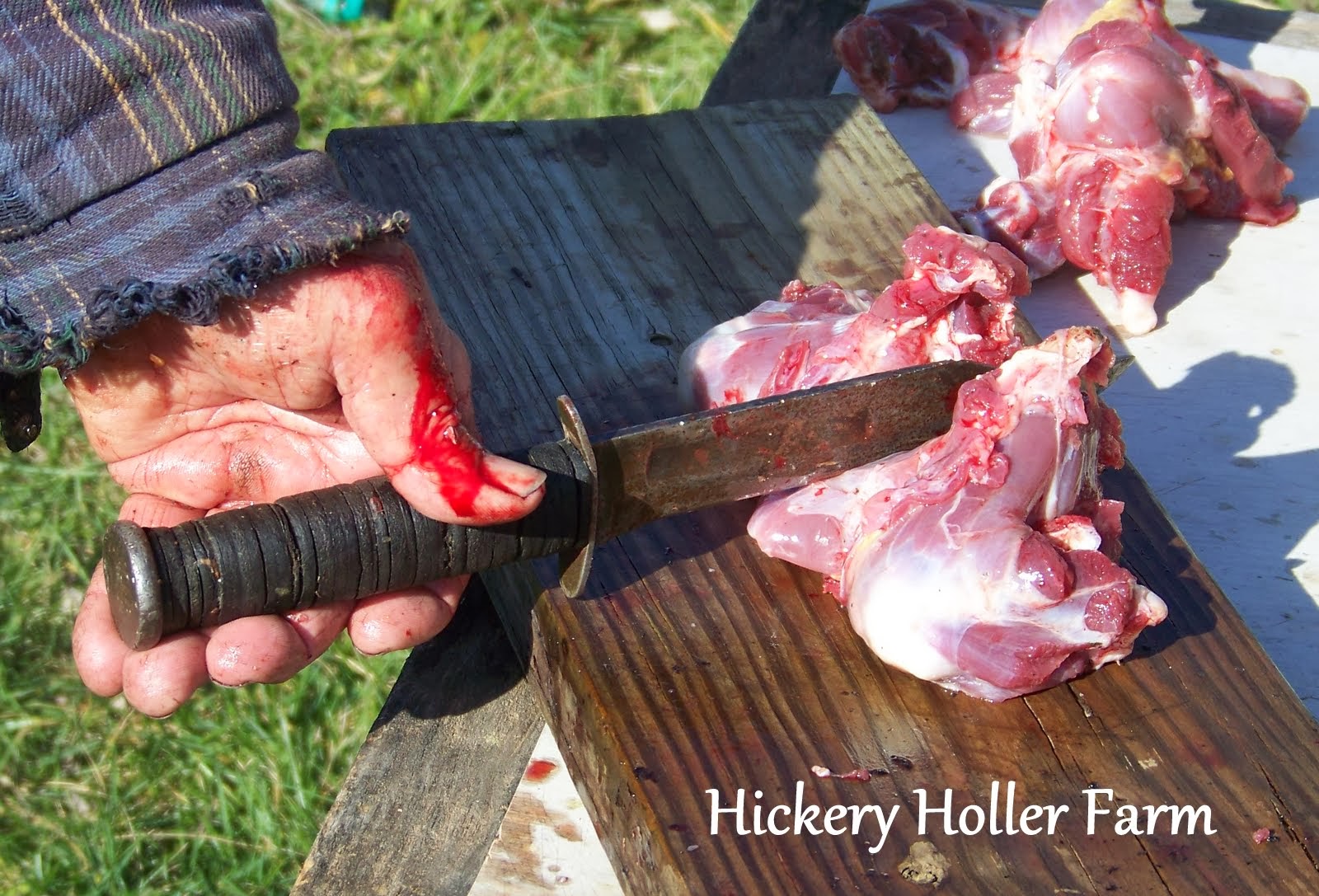
You will need the following tools. Long handles pliers(water pump pliers), large nails, fish skinning pliers, fillet knife and a heavy hunting type knife. This particular one is a military knife and it needs to be heavy duty. A hammer and a board about 2 to 3 foot long. Water is also helpful to wash away blood.


 To kill the turtle you are going to tap the front of the shell and get your turtle to open it's mouth. Grab the top lip with your pliers and pull the head to extend it and quickly cut the head off with your heavy knife. Make sure your knives are sharp before you begin. Now let your turtle bleed out. Sometimes it helps to hang the turtle upside down so that the blood drains quicker. 


Your turtles muscles will still continue to move so this requires some wrestling but grab those feet and extend them and you want to cut them off at the first knuckle right behind the claw. It is nothing but gristle right there and you should be able to cut it with a good fillet knife.  


Now take that good sharp fillet knife and run it between the top and bottom shell between the two legs. There is a little groove right there on the side. Your knife should go right in that groove. 


Now run that sharp fillet knife around the shell cutting the skin away from the top shell. 


Once cut away from the shell you will have to take your heavy military knife and tap it with a hammer through the bony neck to release the top portion of the shell. It will still be connected at the tail. 


Lift that top shell at the neck.


Hold the bottom and twist the top shell separating it at the tail. 


Now you want to clean off all entrails leaving nothing but meat and tendons. When you clean the entrails out the neck will come out also. Save this because this piece is the best piece of meat according to my husband. This is one of the few white portions of meat on the turtle other than the back strap.  


Now take one of your large nails and nail it through the middle of your turtle through the bottom plate of the shell or skid plate to your board to hold it down.


Run your filet knife just under the leg skin of all 4 legs and split the skin.


With your fillet knife skinning out that front leg meat by simply running your knife between the meat and the skin all the way around leg. You cut it loose in one place where it attaches to the shell. 


Then remove the entire leg bone and all. 


Your front leg meat should look like this. 


Now repeat the process on the rear legs. The rear legs will come out attached as one piece. Simply take your heavy knife and tapping it between the two legs to break them apart where the tail once was. This separates each leg. 


This will give you 4 legs and a neck piece. 


You are almost finished. Now for that back strap which is probably the best piece of the turtle. Take the upper shell And place your heavy knife right beside the backbone and tap with hammer breaking through ribs. Now go to the other side of the rib and repeat. 


Now run your fillet knife underneath this strip and lift. You should get a strip of pure meat. Remove the strip on the other side of the backbone the same way.  


Now trim the small rib pieces off your back strap and you are done. 

We then soak our meat overnight in salt water to clean and help draw out the blood.  An average turtle will yield about  2 pounds of meat. Twenty years ago my husband used to sell turtle meat around the New Orleans area. It averaged then about $16 a pound. Turtle meat does not taste like chicken and is a darker and richer meat almost similar to a veal. 

From there your meat can be canned or frozen for future use. Next I will post how to can the meat. 

Blessings from The Holler

The Canned Quilter


Wednesday, October 30, 2013

Henhouse To Table


Back in the spring and early summer I had a neighbor who also has chickens come by and wanted to trade a clutch of her chicken eggs for some of my Buff Orphington eggs for her to hatch. I like the Buff Orphington breed of chicken as I think they make a great farm chicken. Large enough to be able to use them for meat, docile so that I am not being chased by flogging roosters and reliably laying large brown eggs throughout the year. And even better the willingness to hatch their own eggs. I always have at the least two hens go broody a year to ensure that my flock always has a clutch or two of chicks to replenish the flock.  


Not wanting to eat the neighbors eggs because I did not know how far they were in the hatching process I put half the fertile eggs under a broody hen and the other half in the incubator with turkey eggs that I had just set. Once the eggs hatched the chicks were all black but one and I put them all back under the old hen to raise. 


The old hen out in the shed was shut up in a partitioned off corner of the goat barn. She was snug and warm with lots of straw and a safe place to raise a brood.   


Behind a wire fence and locked door nothing could get to the chicks and they were raised there until they were old enough to turn out into the goat yard. 


 After the mother and other  chicks almost pecked the little yellow one to death she was rescued and brought into the house and became a pet we call Paula. O Wise One is convinced Paula is deaf because of the pecking to her ear area and she lives away from the black chickens. 


I had hatched out some young Buffs earlier in the spring and they were integrated back into the main flock and will become part of my main egg production flock. The Bourbon Red turkeys will also be butchered other than the ones that are out with the gobbler and hens and raised by the turkey hen. These young hens and gobblers already a part of the flock I will keep as my gobbler is getting up in age and this young stock will eventually replace the older gobbler and hens. They themselves are a sealed flock isolated from the turkeys that I intend to butcher. 

I know many people buy meat chicks to raise and butcher. I do not! We butcher what we raise on the farm and this year it was the neighbors black chicks now half grown. Raised off some grain and a steady diet of grass and garden culls throughout the gardening year and kitchen scraps.   

With cool weather arriving it was time to begin the butchering process so that we can get it over before the severe winter weather arrives. 


So yesterday my spring black chicks became canned chicken meat and rich bone broth for the pantry. Healthy and farm raised and used regularly for casseroles, soups, noodles and gumbos throughout the year.   


And chicken breast are freezing in the freezer. They will eventually be vacuum sealed in serving size portions. Lean white meat, farm raised and butchered.  

So as the leaves continue to turn and fall off the trees and the weather cools, a soft autumn rain falls here on the holler. It has been raining off and on since yesterday and is predicted to rain again tomorrow. So as the weather worsens I will continue to cook down my butchered birds and once we finish then start butchering turkeys. With 16 chickens and 9 turkeys to be butchered we will try to do a few every day or to. Once they are processed then we butcher some more. 

It may take us a week or two but slowly we will get it all done. 

Blessings from The Holler 

The Canned Quilter


Sunday, September 15, 2013

Roosters And Freezers


As we continue to can O Wise One and I realized freezer space was starting to dwindle rapidly. With chickens, rabbits and turkeys still to butcher in the next month or two we started looking for ways to help clean it out. Yes I have pretty well managed to fill One chest, one upright and half of a side by side freezer and I am still preserving.  


We have added lots of fish and rabbit in the last month or so on top of all the vegetables. Despite putting as much as possible in jars we continue to have space issues.  


So in the interest of cleaning out some much needed room we have started putting some meat in jars. Remember those roosters my neighbor brought me to trade for an extra Buff rooster that I had. 


They have been cooling their heels in the back of my freezer so it was time to deal with them to make way for the young ones about ready to be butchered. A good Saturday morning project to take a break from tomatoes.  


So the roosters went in the roaster and simmered on low for a good long time. Then we picked the meat off the bones and allowed the broth to cool in the fridge until any fat rose to the top and hardened. Then the fat was skimmed off the top and fed to the big dogs over their dog food. The remaining meat and broth were canned. That canned chicken is so handy for so many different kinds of recipes. And the additional bone broth was canned for use in cooking also. Bone broth is so good for you.   


Monday it is back to canning tomatoes. 


And the dehydrator is still humming away. My bags are filling with lots of veggies to eventually go into jars.  


This weeks tally

27 quart jars canned tomato sauce
2 pints canned tomato sauce
7 pints canned chicken
2 pints canned chicken broth
5 bags frozen green pepper chunks


Seeds saved

watermelon...drying
cantaloupe ...fermenting
tomato oxheart..drying
tomato determinate paste...drying
Jade bush green bean...drying
French Horticulture (half runner)..drying
Bell Peppers ....drying
Dill Seeds....drying


I still have some rabbit in the freezer I want to put in jars. And the dehydrated goods continue to pile up. Next week I will continue to dehydrate watermelon and cantaloupe. The okra and cucumbers are just about done and still to deal with: peppers, carrots, potatoes, onions, and apples.

Still in the garden

Potatoes
Watermelon
Cantaloupe
Tomatoes
Green Peppers
Lettuce
Turnips
Broccoli
Cabbage
Brussel Sprouts
Zucchini

I hope everyone has a safe and blessed weekend and I will see you on Monday morning.

Blessings from The Holler

The Canned Quilter


Related Posts with Thumbnails