Saturday, September 28, 2013

Weekly Tally And Farm Update


It is indeed that time of year again. I am starting to see everyone putting out Halloween and Autumn decorations. And of course the stores already have Christmas stuff out. That just makes me so mad!  


The Apples are crisp and plentiful as are the critters wanting to eat them. They are predicting rain this weekend and O Wise One has been working on cleaning out the garden of all the finished crops. Next thing you know we will be picking up pecans and walnuts. With rain and wind in the forecast we will really have to watch the apple trees that hang heavy with fruit right now. In high winds it would be easy for them to break. O Wise One has cut some sticks and braced them up already and even though we thinned them, looking back I think we could have removed a few more. Next week apples are definitely on the canning to do list! 


The dirt roads are full of hunters these days looking for deer movements and those big bucks. Season opens in November. 


O Wise One made breakfast sausage with the rabbit trimmings from the rabbits he butchered and some ground pork. 


This will go great with those farm eggs, buttered grits and some buttermilk biscuits.


He also smoked some pork for seasoning meat. This was cut into small chunks and frozen in bags. 


This I use in those cream of potato soups and pots of beans.  The pork he purchased at a sale in town this week. 


This Weeks Tally 

11 bags frozen  pork seasoning meat
5 bags frozen rabbit/pork breakfast sausage
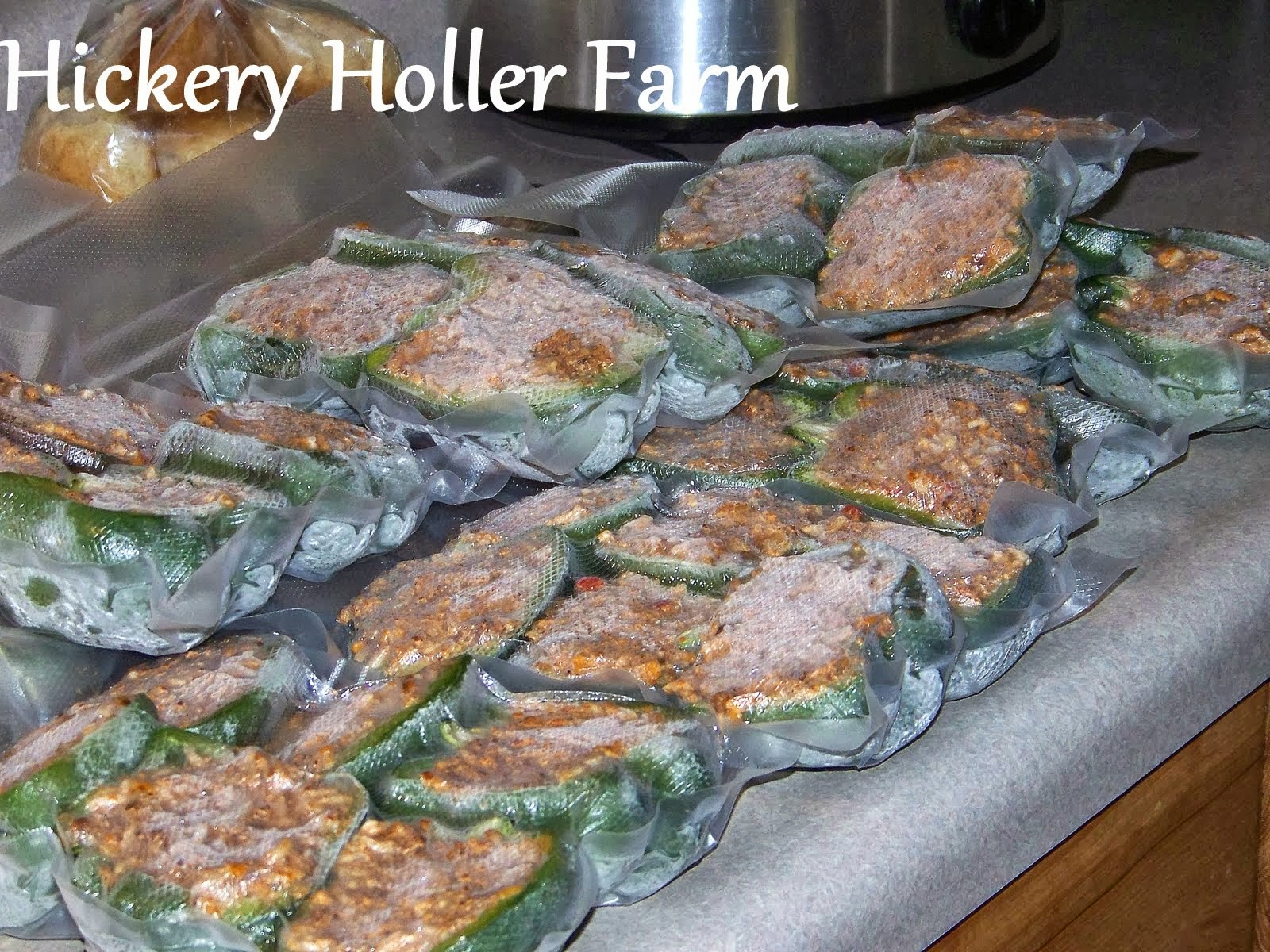
10 bags frozen stuffed peppers
9 pints canned sauerkraut
2 gallon bags dehydrated tomatoes

We continue to have a bowl of watermelon every night with our evening television shows. We will miss the watermelon when they are gone. The cucumbers are just about finished also. 

Still to be canned apples, potatoes, peppers and onions. 


We have started adding jars to the right side of the pantry in among the pots and such. I think we will work on reorganizing and making room for more jars this weekend. 


The left side is completely full,  all 7 16 foot shelves are full. 


As O Wise One pulls up the plants he brings in the seeds that are left on the bushes. I spent some time shelling another tray of both Jade beans and French Horticulture Bean seeds. He took a couple boxes of tomatoes to the lady that runs the small grocery in town. She works 6 days a week daylight to dark running the store and has very little time to garden so he thought to share some with her so she can put them up. She was very happy to receive them. He also has been sharing watermelons with everyone because we had so many. The lady that runs the variety store called me and was amazed at the size of hers : ) Credited it to that rabbit poop. 


The dining table has accumulated quite the collection of seeds all drying naturally under the ceiling fan. Above are dill seed, cantaloupe seed Healey's Pride, tomato Brandywine, tomato Yellow Pear, tomato Oxheart Paste, tomato Unnamed Determinate Paste, watermelon, and pepper California Wonder

One last note of business I would like questions for my Question and Answer post next week if anyone would like to contribute one. 

Well that is another week here in Hickery Holler. Hoping each of you have a safe and blessed weekend and as usual I will see you on Monday, if the good Lord is willin and the creek don't rise. 


Blessings from The Holler

The Canned Quilter

Friday, September 27, 2013

We Have A Winner


We have a Winner! Congrats to Angie over at http://threadcatcher.blogspot.com/ . Angie make sure and email me an address at cannedquilter@yahoo.com by Monday morning so you can collect your prize!

Congrats again and I hope you enjoy the book as much as I did.

The Canned Quilter

Friendly Reminder


Just wanted to remind everyone that I am stopping the drawing at 6:00 pm this evening for the copy of The Funeral Dress book giveaway. If you haven't already don't forget to go over to  this post and leave a comment to enter ! 


Good Luck and thanks so much for all your support and continued reading of the Hickery Holler farm Blog!

Blessings from The Holler

The Canned Quilter


Paranoid of Freedom


I saw this post over at Throwback at Trapper Creek and thought I would share. The words were originally written by Joel Salatin and posted on the Polyface Farm facebook Page


Why are Americans paranoid of freedom?

Yesterday I had the privilege of participating in the final On-Farm Activities Working group convened by
Virginia's ag commissioner after the failed Boneta Bill in last year's General Assembly. Martha Boneta is the
Virginia heroine who was fined $5,000 by Fauquier County for having 8 ten-year-olds at her farm for a birthday
party . . . without a license. Sometimes bureaucrats make huge mistakes by targeting savvy people, and Martha
is savvy. Pretty, female, outspoken, and articulate--whew, baby, that's a combination. Her treatment created
a hornet's nest in the state when previously lethargic people realized just how aggressive and elitist and anti-
property many Americans have become. Especially bureaucrats.

For 30 years Virginia's Right-to-Farm Law has protected stinky farmers from nuisance suits. I've always
called it the Right-to-Stink-Up-the-Neighborhood law. Interestingly, it expressly protects production, but not
processing. Increasingly now, through zoning, business licensing, land preservation and other techniques
farmers protected in nuisance production are being shut down when they attempt processing or agri-tourism
type activities on farms.

This was the third and final meeting of the working group and it certainly created some interesting exchanges. On
our side, we had three members of the working group: Martha Boneta, Lois Smith, president of the Virginia
Independent Consumers and Farmers Ass. (VICFA) and yours truly. On the other side sat Virginia Farm Bureau,
Va. Agribusiness Council, Va. Ass. of of Counties, a couple of large-scale farmers and a couple of county planners/
zoning administrators.

The first epiphany for me was in the first meeting when I learned that Virginia wineries had created special
entertainment and sales privileges for themselves nearly 20 years ago in response to heavy-handed regulation
primarily in Albemarle County. The right to sell, host events, and collaborate with other farmers in sales did not
extend to any farm except wineries. I think this working group, when we're finally finished, will rectify much of this.

A sticking point is processing. One thing you learn very quickly when dealing with the government regulators
is that for the most part, they have no heart and no appreciation of scale. If I fix a neighbor's tractor in my shop, and
charge him $100 for the job, I'm a criminal without a special use permit, shop license, building inspection for the
structure, etc. It's treated the same as a 50-employee (oops, Obamacare--49 part-time employee) repair business. Ditto
for if I sell a neighbor's pumpkin in my farm store.

Some localities like Rockingham County and to a certain extent Augusta have created scale and administrative
friendliness to these kinds of imbedded small-scale businesses in agriculture zoning. Others have not. Indeed,
York Co. Virginia either has or is in the process of eliminating agricultural zoning. In that case, farms must pay the
same taxes as if the land were being used for residential market value. That drives all the farmers out of business
because the land can't sustain those high taxes. California, decades ago, passed a law that no property could see
an increase in property taxes more than 1 percent per year, period. That's a great law. It keeps people from being
driven off their farms and property just because some special group doesn't respect land owners or farmers.

Local control, local control the other side shouts. Who better to determine what a community should look like
than the people in that community? Okay, let's let communities opt out of the civil rights act--some would like to.
Let's let some opt out of the second amendment--right to bear arms--some would like to. How about freedom of
religion?--some communities would love to opt out of that one. You see, our culture has decided that some things
are so inalienable we can't afford to let enclaves opt out. The right to life, liberty, and property is one of those.

My argument throughout this working group process is that it doesn't help a farmer to be able to sell a chair if
he's precluded from building it (manufacturing and therefore illegal in agricultural zoning). A huge gap exists
between a tree and chair; most consumers don't want to buy the tree, but many would like to buy the chair. This
segregationist stance toward economic commerce and business has turned farmers into colonial serfs for the urban
lords who enjoy the value-added benefits of turning the raw commodity into a salable product.

What struck me during the final meeting yesterday was how paranoid Americans are about liberty. I was
reminded of the dire prophecies adorning the front pages of all newspapers 30 years ago during the early days
of the home schooling movement. Not enough jails for the the academically neglected miscreants. Kids doomed
to a life of street crime and homelessness. Bankrupt society building insane asylums for the socially maladjusted.
The headlines, parroting the best prognostications of the educational elite, predicted cultural doomsday if such a
freedom like home schooling were allowed to persist. None of this has materialized. The aberrant cases do indeed
make the news, as if public schools create no aberrant cases.

During this working group tenure, I've been accused of wanting Wal-Marts on farms, strip-tease clubs in the
pasture (is this really worse than a Tyson chicken house in a pasture?), and that I'd go to Wal-Mart to buy chairs to
resell in my farm store. I was accused of wanting 10,000 people-per weekend Woodstocks on our farm, along with
Smithfield slaughter plants and a host of other hyperbolic possibilities. Trust me, Polyface customers don't want
chairs from Wal-Mart, and certainly not from our farm store.

It smacks of the same hyperbole leveled at me for wanting consumer freedom of food choice. If you want to
come to my farm, ask around, smell around, and make an informed opt-out choice from government-sanctioned
food, as consenting adults with the right to freedom of contract we should be able to do business without a food
police bureaucrat coming in between our transaction. Our government-industrial food complex orthodoxy that
promotes drugs for health, grains for diet, and chlorine for sanitation views such a choice policy as heresy. But
how does our culture handle the unorthodox, the non-conformist, the innovator?

I find it fascinating that we universally love rebels in foreign countries, but rebels in our own country get
visits from the SWAT team to confiscate their food and livelihood. Seldom in the course of human history has
granting liberty resulted in terrible things. Usually creating more government control--called tyranny before these
dependency days--resulted in terrible things.

Most people don't realize the battles wineries fought just for the freedom to sell their own wine on their own
farms. Their regulations are still onerous and tyrannous. But they won some freedom. It's time to extend that to
a lot of other things. We haven't seen the dire things that the naysayers predicted when wineries were given the
freedom to sell their wines. We wouldn't see it if farmers received the freedom to host birthday parties and fix
neighbor's tractors.

Indeed, if our farm did figure out a way to attract 10,000 people per weekend, imagine how many jobs that
would create. Why can't we encourage each other in liberty, instead of looking at everything from a fearful and
distrusting standpoint, a liberty-paranoid paradigm? In the minds of the status quo, a farmer being able to plop down
two confinement hog factories next to my farm is a wonderfully benevolent thing. But butchering a pig is an assault
on the entire community. Really?

This weekend Daniel and Sheri and I spoke at the Mother Earth News Fair in Seven Springs, Pennsylvania
and Daniel and Travis (my 10-year-old grandson) rode up the ski lift to come down on the luge track. Here was
my grandson sitting in a bench up in the air, no seat belt, dangling along, and our society thinks that's great. But
a glass of raw milk--too much risk. Just a couple of weeks ago down near Richmond, Virginia hosted the first U.S.
running of the bulls--12,000 people crammed into an arena with a bunch of bulls. Risk? No problem. But Aunt
Matilda's home made pickles? Hazardous.

Every year we know 50 children will drown in back yard swimming pools. Risk? No problem. That's more
deaths than even government experts have attributed to raw milk . . . ever. But no, we can't let people drink raw
milk. Too risky. Bungee jumping? No problem. Homemade cheese or charcuterie--far too risky. A culture that
denies risk denies innovation. Denying innovation denies culture of tomorrow's answers to today's problems.

Risk and innovation demand freedom. You can't have a no-risk policy and preserve an innovation climate.
The two are mutually exclusive. Risk and freedom go hand in hand. When Jefferson penned the Declaration of
Independence, he envisioned an innovative civilization the likes of which had never been tried. It was risky. The
only way to try was to demand liberty. Why are so many Americans now scared to death of liberty?


Blessings from The Holler


The Canned Quilter


Thursday, September 26, 2013

Kraut


As if right on cue I see a few leaves starting to yellow up when looking out my windows these days. The nights of the last few days have been illuminated by huge beautiful harvest moons. Our windows are again open and we enjoy the nip in the air when sleeping under open windows serenaded by the owls and coyotes. Snuggled under a light quilt for the first time this year. 

And like every fall the sauerkraut is ready. Many weeks ago I shredded the last of my cabbage harvest after making freezer slaw and freezing some for smothering. 


Every year I grow the open pollinated heirloom Early Jersey Wakefield. A small conical headed cabbage that does really well on my farm. It seems to resist splitting much better than the larger headed varieties and has become our standard cabbage. 


We start them from seeds every year right here on the farm and as you can see above they reward us with wonderful harvests of fresh crisp cabbage heads.


And every year I dig out the trusty old crock and start shredding cabbage.


I have several antique slaw cutters that belonged to various members of O Wise One's family but I just simply use my cheap Walmart mandolin slicer. Once chopped I use 3 tablespoons pickling salt to every 5 pounds of shredded cabbage. Pack the shredded cabbage firmly in the crock. I use a wooden rolling pin that has no handle to firmly pack my kraut and then sprinkle the salt over the top. Then I add another 5 pounds and sprinkle the salt over the top. Do this until you are within about 6 inches of the top or have the amount of kraut that you want. If the brine does not cover the cabbage I make an additional brine of  1 1/2 Tablespoons pickling salt to 1 quart water. Then I cover my cabbage with cheesecloth or maybe even large cabbage leaves that have been set aside and cover everything with brine. Then I set an old dinner plate on top to weight it all down. You can also use a plastic bag filled with water.   


Then I let my crock set in a cool and out of the way place for between 3 to 6 weeks. Make sure and cover with muslin to keep out any fruit gnats and insects. Every day I skim off any scum that may form. This will start to bubble and smell awful. And I do mean awful. Once the kraut stops bubbling I start sampling a little that I have taken out and rinsed. When it is as salty as I want it then I remove my kraut and rinse with cold water through a colander. Then it is ready to can.


I heat my jars and lids.


And place my rinsed kraut in a large pot. I mix up a new brine of 1 1/2 Tablespoons pickling salt to 1 quart of water. Mix enough brine to cover kraut completely. Behind this pot you will see a pot of extra brine heating to make sure I have enough brine when I start filling my jars. You want everything hot. 


Now I bring my kraut up to a simmer and I want it at 180 degrees. DO NOT BOIL! 


Pack hot sauerkraut into hot jars and I like to leave about 1 inch headspace. Then cover with hot brine from the pot or from the extra pot of brine if you need it. Remove air bubbles. Wipe rims and place hot lids and rings on each jar. Finger tighten only. 

I process my pints 15 minutes in a boiling water canner. Quarts 20 minutes. Remove from canner and allow to cool overnight. 


Since I had a few jars left from last year I only made 9 jars of kraut. That should be more than enough to last us through the winter or until the next cabbage harvest.  


This kraut will be served with O Wise One's homemade venison and pork smoked brats in the freezer.  

And that is the last of my cabbage for the year either put up in freezer slaw, frozen in bags for soups and smothering or sauerkraut. Another crop down for the year.  The crock is washed and tucked back away till next sauerkraut season. 

Now I know there are many different way to make kraut out there and I am curious how many of you still make kraut and how do you make it. Do you ferment it in crocks  like mine or do you ferment your kraut in the jars?

Blessings from The Holler

The Canned Quilter 


Wednesday, September 25, 2013

Mexican Peppers


Even though we are over half way through September the produce still continues to come through the back door by the bucket full. The peppers are my crop of the week to deal with. 


The potatoes and onions are a close second of crops to deal with. I want to chop some onions to freeze for cooking and dehydrate some more potatoes. But first to deal with the peppers. 


These are the open pollinated variety California Wonder. They tend to do wonderfully for me planted in my flower beds along the concrete sidewalk. They flourish in the heat radiating from the concrete. So every year I plant them there and every year they provide me with an ample fall crop of beautiful peppers.  Some I allow to ripen and others I pick green. These are washed and ready to cook. 


You can dunk these in boiling water for 3 minutes but I just pop mine in the microwave for 3 minutes instead. I remove them and allow them to cool. 


I browned 2 pounds of ground beef and 1 pound of ground venison. Added 3 cups onions and a cup of red peppers chopped. Three cloves of chopped garlic and 5 Tablespoons of Chili powder. Then I added 1 quart of homemade tomato paste and allowed it to cook down for about 10 minutes on a low simmer. 


Then I grated some sharp cheddar. 8 ounces for every pound of meat.


Then let your meat mixture cool. And I added 1 1/2 cups cooked rice for every pound of meat and the cheddar to the cooled meat mixture. 


Now at this point you can get creative. I added a little hot sauce and some Mexican spices and red pepper flakes and some Worcestershire sauce . Don't forget salt and pepper. You can also add black olives chopped, black beans or maybe corn to the mix. Whatever your family likes.  


Now I stuff my blanched peppers with the meat and rice mixture. 


They go on cookie sheets once stuffed to be frozen overnight in the freezer.


Then they are ready to bag.


Four of mine fit nicely in a quart vacuum bag.


I now have 10 bags of frozen stuffed pepper meals conveniently frozen and ready for that winter meal in  a hurry. I simply take them out the night before and let them thaw in the fridge overnight. The next afternoon I put them in an 8" baking dish and spoon salsa over the top of each one and cover with aluminum foil. I allow them to bake in a preheated 350 degree oven for about an hour and 15 minutes to an hour and a half or until a meat thermometer stuck into one reads done for hamburger. Then I remove the foil and sprinkle some Mexican cheese mix over the top and put it back in the oven for a few minutes to melt the cheese. I serve mine with a cornbread salad and maybe Mexican corn.  My family likes a little scoop of sour cream over the top too.   

These are a great convenience meal for me on those days that I am quilting and I know that I have a hot dinner thawing in the refrigerator for the evening. These can also be placed in the crockpot on low for about 4 to 6 hours depending on your crockpot!

Don't like Mexican? Think pizza, ground beef or Italian sausage mixed, pepperoni, mushrooms, olives, onions, peppers, pizza spices, tomato sauce and shredded mozzarella. Topped with pizza sauce and pizza cheese served with veggies and bread sticks.

Or maybe Italian? Broken spaghetti cooked or small pasta, onions, peppers, mushrooms, and Italian seasonings with chunks of mozzarella mixed in or maybe ricotta with mozzarella over the top.  

Blessings from The Holler

The Canned Quilter


Tuesday, September 24, 2013

Questions And Answers

Many times during the week I get questions from my readers and I need a little more space than just a comment square so I thought I would share the answers with everyone. I think that these questions are good ones for everyone to be able to read and many do not go back and reread the posts to see those answers. I think I will start a weekly Q & A post. 


Can you please tell me how you season your spaghetti sauce? I am making tomato sauce for the first time as we have had an abundance of tomatoes this year. After cooking them down and blending them I am freezing unseasoned except for a little lemon juice for color. When I thaw I need a foolproof seasoning and I have learned soooo much from you and although there are a million recipes out there, I would like one from someone I know and trust! Thank you so much for all you do on your blog!


I can my tomato sauce unseasoned also. I add a touch of salt and lemon juice to my jars. Once I open a jar then I add what my family likes. I have never met 2 families that like spaghetti sauce the same way. You have to season it like your family likes it.  As for me personally I use some basil either frozen in olive oil cubes or dried from my pantry, same with oregano. My family also are huge garlic eaters. We put garlic in everything. I also think a little sugar helps to bring out the tomato taste. My family are really purists. They like chunks of onions sauteed and peppers either roasted and frozen or fresh frozen and sauteed in olive oil. I leave my veggies whole but you can also run your immersion blender through the veggies and puree them into the sauce. I usually add browned turkey or venison and homemade Italian sausage.

If you are looking for a set recipe I do not have one. I am not that kind of cook. Every herb is different depending on how I preserved it, the garden conditions that year and when I picked it and even what variety. So many variables. Some years my tomatoes are sweeter than others.

I saute my meat. Then my vegetables. Add my tomato sauce from jars and then start adding my seasonings about a 1/2 teaspoon at a time. Let it simmer on super low for about an hour and taste. If you need to add more seasonings then add another 1/2 teaspoon. Be very careful though because remember you can not take anything out.

I like to let my sauce set in the refrigerator for about 24 hours and then serve as I find the herbs and spices are mellowed by then and the taste is much better.

In Cajun Louisiana they get really creative with spaghetti sauce. You can find chicken spaghetti, pork chop spaghetti and even alligator or frog back spaghetti. Anything can be cooked down with that traditional red sauce that we associate with spaghetti.

My first husbands grandmother ( from Italy) cooked her spaghetti sauce it seemed for days. She always made from scratch and dried ricotta cheese to grate over the top and dropped eggs into her sauce. Her sauce was to die for!

At the risk of repeating myself. Find what your family likes, develop it and stick with it. For me recipes are guidelines to making something but not set in stone. I think so many cooks are afraid to experiment and truly make a recipe their own.


Can you tell us more about your vacume sealer??


 April my present Vacuum sealer is a FoodSaver V840. This is actually the second sealer that i have owned. years ago we bought our first sealer from Walmart. After a short period of time it ceased to work. It was still under warranty so my husband called Foodsaver. They said that the model that we had bought was made exclusively for Walmart and had some sort of problem from the factory. So they sent us this machine as a replacement. It has held up fine for many ears now with very few problems. And my sealer does get a workout. It is used 12 months out of the year and many months used very hard especially around harvest and butchering time.  It is by no means a fancy or expensive machine but just a middle of the road everyday model. 
What a fabulous post. I especially like your recipe for apple pie filling. I've never seen clear jell, can you suggest an alternative?

ClearJel is a type of corn starch that can be cooked with fruit as a thickener to make pie filling then recooked ( baked )  and keep it thick consistency yet remain shelf stable. You can find ClearJel online at Amazon.com. It does run about $8 a pound. 

As an alternative I get perma Flo from the Amish. It is a very similar product again made from corn starch and gives similar results.

Below is a link to using Perma Flo to make pie filling. Just use this technique with my recipe!


Blessings from The Holler

The Canned Quilter


Monday, September 23, 2013

Winter Meat


O Wise One took advantage of the cooler temperatures to start the butchering of some of our winter meat. The young rabbits were ready to go in the freezer and so he decided to butcher them. These young rabbits were all born in early summer and fattened of with a combination of pulled weeds, garden culls and some purchased rabbit chow and alfalfa hay. In return we have added 17 bags of rabbit pieces to the freezer stash and 4 bags of rabbit loin. 


This is pure, white meat naturally low in cholesterol and fat. Easily raised in a small area with their diets easily supplemented with weeds and twigs around the homestead and garden.  On this homestead we use chicken/ turkey and rabbit meat interchangeably in most recipes. You are just as likely to eat fried or barbecued rabbit at my table as chicken. 


These loin strips will become breaded strips either baked or fried. I have even used them in stir fry. 


The livers are frozen and become catfish bait for future fishing excursions.


Every spring we have several litters born on this farm and spending their whole life here.


Raised in easily and economically built small cages and tractors. 


While most homesteads feast on beef we instead get through our winters on venison, some pork, rabbit, chicken, turkey and fish.  This results in investing in very few fences, stocking small amounts of hay for the two goats, and purchasing some wheat straw for bedding and garden mulches.

 We do feed our laying hens through the winter, butchering any extras and also feed our flock of adult turkeys also through the winter butchering our spring turkey chicks in the fall as soon as they are large enough to butcher. We maintain our breeding stock of rabbits also through the winter which is 3 does and a buck. 

            Blessings from The Holler

          The Canned Quilter


Related Posts with Thumbnails